What Is AI SEO? A Complete Business Guide for the AI Search Era
Discover how AI SEO helps businesses improve visibility across Google AI Overviews, ChatGPT, Gemini, Perplexity, and modern search engines through semantic SEO, entity optimization, and topical authority.
Artificial Intelligence is changing how people search for information online.
Instead of clicking through ten blue links, users increasingly receive direct answers from AI powered search systems like Google AI Overviews, Google AI Mode, ChatGPT, Gemini, Microsoft Copilot, and Perplexity AI.
Because of this shift, businesses need more than traditional keyword optimization.
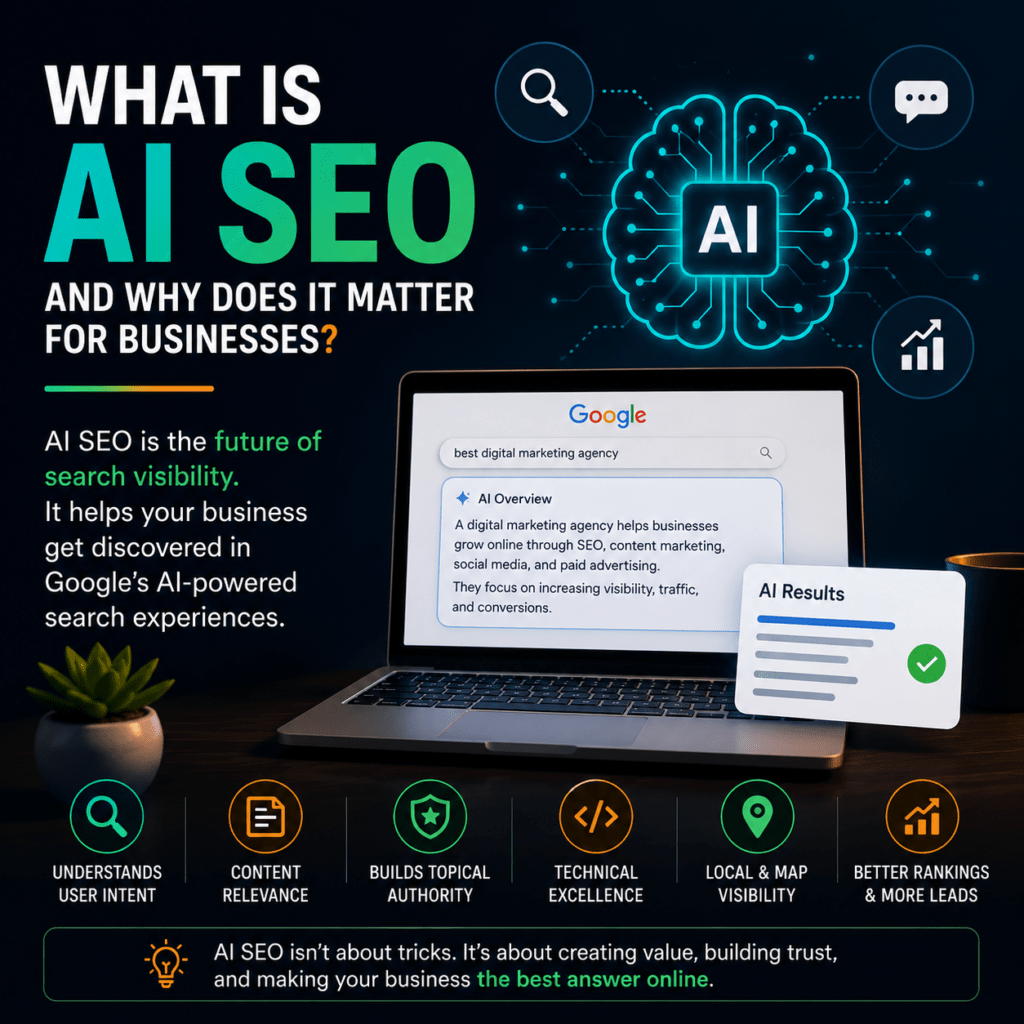
AI SEO is the process of helping search engines and AI systems clearly understand your business, expertise, products, and services so they can confidently surface your content when users ask relevant questions.
It combines technical SEO, semantic SEO, entity optimization, structured data, topical authority, and people first content into one long-term strategy.
Businesses that invest in AI SEO today are preparing their websites not only for Google’s current ranking systems but also for the future of AI-driven search.
What Is AI SEO?
AI SEO is the practice of optimizing a website so artificial intelligence powered search systems can accurately understand, trust, and recommend its content.
Unlike traditional SEO, which mainly focuses on keyword rankings, AI SEO also emphasizes semantic relationships, entity recognition, search intent, structured information, topical authority, and content quality.
The goal is not simply to rank higher.
The goal is to become a trusted source that AI search engines are willing to reference, summarize, or recommend.
or,
AI SEO is a modern search optimization strategy that helps websites become easier for Google AI Overviews, AI Mode, ChatGPT, Gemini, and Perplexity to understand. It combines traditional SEO with semantic search, entity optimization, structured data, technical SEO, topical authority, and user-focused content to improve both organic rankings and AI-generated search visibility.
or,
AI SEO (Artificial Intelligence SEO) is the process of optimizing a website so AI-powered search engines can better understand its expertise, context, and trustworthiness. It extends traditional SEO by focusing on entities, semantic relevance, structured information, topical authority, and helpful content, making it more likely that a website appears in Google AI Overviews and AI-generated answers.
Search has changed more in the last few years than it did during the previous decade.
For many years, search engine optimization mainly focused on helping web pages rank for specific keywords. Businesses created content, optimized title tags, built backlinks, and waited for Google to rank their pages.
Today, that approach alone is no longer enough.
Modern search engines use artificial intelligence to understand topics, relationships, user intent, and the credibility of information before deciding what to show users.
Instead of only displaying traditional search results, platforms such as Google AI Overviews, Google AI Mode, ChatGPT, Gemini, Perplexity AI, and Microsoft Copilot increasingly generate direct answers by combining information from trusted sources.
This changes how businesses earn visibility.
Rather than optimizing only for rankings, organizations must now optimize to become trusted entities that AI systems recognize as authoritative sources.
That is where AI SEO becomes important.
AI SEO is not a replacement for traditional SEO.
Instead, it builds on traditional SEO by adding semantic understanding, entity optimization, structured information, topical authority, and AI-friendly content architecture.
The objective is simple.
Help both search engines and AI systems understand who you are, what you do, and why your business deserves to be recommended.
As an AI-driven entity SEO Expert in Bangladesh, I have seen how this shift is transforming search strategy for businesses across different industries.
Instead of chasing individual keyword rankings, modern SEO focuses on building long-term authority that works across Google Search, AI Overviews, ChatGPT, Gemini, and future AI search experiences.
In this guide, you’ll learn:
- What AI SEO actually means
- How AI search works
- Why traditional SEO alone is no longer enough
- How businesses can prepare for AI-powered search
- Which AI SEO strategies create long-term visibility
- Common myths and mistakes businesses should avoid
Whether you’re a business owner, marketer, SEO professional, or startup founder, understanding AI SEO today can help you build sustainable organic growth for the future.
What Is AI SEO in 2026?
Artificial Intelligence has fundamentally changed how search engines discover, understand, organize, and present information.
For years, SEO largely revolved around improving keyword rankings. Businesses optimized title tags, created landing pages, earned backlinks, and tried to rank higher than competitors.
Those practices are still important.
However, modern search engines now evaluate far more than keywords.
Google’s AI systems attempt to understand:
- Who created the content
- Whether the source is trustworthy
- How deeply the topic is covered
- Whether the information answers the user’s actual intent
- How different concepts relate to one another
- Whether the website demonstrates real expertise
This shift has given rise to AI SEO.
Instead of optimizing only for search engine algorithms, AI SEO focuses on making your business understandable, trustworthy, and recommendable across AI powered search platforms.
Rather than asking,
“How do I rank this keyword?”
AI SEO asks,
“How can search engines confidently recognize my business as an authority worth recommending?”
That difference changes everything.
AI SEO Definition
AI SEO (Artificial Intelligence SEO) is the process of optimizing a website so AI powered search systems can understand its expertise, trustworthiness, semantic meaning, and relationships between entities.
It combines traditional SEO with modern optimization methods including:
- Semantic SEO
- Entity SEO
- Technical SEO
- Structured Data
- Topical Authority
- Search Intent Optimization
- Information Gain
- E-E-A-T
- AI Friendly Content Architecture
The objective is no longer limited to ranking a page.
The objective is helping AI systems confidently recommend your business when users ask relevant questions.
Why Traditional SEO Alone Is No Longer Enough?
Imagine two websites.
Website A
- Uses keywords correctly
- Has backlinks
- Optimized title tags
- Basic blog articles
Website B
- Strong topical authority
- Connected entity relationships
- Structured data
- Expert authorship
- Original research
- Helpful content
- Semantic architecture
- Technical excellence
Five years ago, both websites could compete.
Today, AI systems are far more likely to trust Website B.
Why?
Because AI doesn’t simply count keywords.
It tries to understand expertise.
That is exactly what AI SEO helps build.

Traditional SEO vs AI SEO
| Traditional SEO | AI SEO |
|---|---|
| Focuses heavily on keywords | Focuses on topics and entities |
| Optimizes individual pages | Optimizes entire knowledge ecosystems |
| Ranks webpages | Builds authority across AI platforms |
| Keyword density matters | Context and meaning matter |
| Backlinks are a major signal | Trust signals are evaluated together |
| Search intent is important | Search intent plus conversation flow are important |
| Mostly Google Search | Google, AI Overviews, ChatGPT, Gemini, Perplexity, Copilot and future AI search |
Traditional SEO has not disappeared.
AI SEO simply expands it.
Businesses that combine both approaches typically build stronger long-term visibility.
Why Search Engines Are Becoming More Human
People rarely search like this anymore:
Instead, they ask:
Who is the best SEO expert for an ecommerce business in Bangladesh?
Or,
How can I improve my Google AI Overview visibility?
Or,
Which SEO strategy works after Google’s latest AI update?
These conversational searches require a much deeper understanding than simple keyword matching.
Modern AI systems analyze:
- Context
- Intent
- Previous conversation
- Related concepts
- Entity relationships
- Trust signals
Your website must therefore answer questions the same way people naturally ask them.
This is one reason conversational content performs increasingly well in AI search.
AI SEO Is About Building Understanding
Think of your website as introducing your business to someone for the first time.
That person wants answers.
Who are you?
What do you do?
Why should anyone trust you?
Who have you worked with?
What makes your expertise different?
Can your claims be verified?
AI systems ask similar questions.
Your website should answer all of them clearly.
This is why modern SEO relies heavily on:
- About pages
- Author pages
- Organization information
- Case studies
- Reviews
- Structured data
- Helpful educational content
- Internal linking
Each element strengthens Google’s understanding of your business.
The Core Pillars of AI SEO
Modern AI SEO is built on several interconnected components rather than one ranking factor.
1. Entity SEO
Instead of recognizing only keywords, Google identifies real world entities.
An entity can be:
- A person
- A company
- A product
- A location
- A service
- A technology
- An organization
For example,
is an entity.
NexaForge IT
is another entity.
Google AI Overviews
is another entity.
Good AI SEO clearly defines these relationships so search engines understand how they connect.
2. Semantic SEO
Semantic SEO helps search engines understand the meaning behind content.
Instead of repeating one keyword twenty times,
AI SEO naturally covers related ideas such as:
- search intent
- topical authority
- structured data
- schema markup
- E-E-A-T
- Knowledge Graph
- technical SEO
- information gain
- user experience
Together these concepts paint a complete picture.
3. Technical SEO
Even the best content struggles if search engines cannot properly crawl or understand a website.
Technical SEO includes:
- crawlability
- indexing
- Core Web Vitals
- XML sitemaps
- canonical tags
- robots.txt
- internal linking
- structured architecture
- page speed
Strong technical foundations help AI systems process information more efficiently.
4. Topical Authority
Publishing one article about SEO does not establish expertise.
Publishing dozens of interconnected resources covering every major SEO topic begins to demonstrate authority.
For example:
AI SEO
↓
Entity SEO
↓
Semantic SEO
↓
Technical SEO
↓
Google AI Overviews
↓
Structured Data
↓
Topical Maps
↓
Knowledge Graph
↓
Local SEO
↓
AI Content Optimization
Each article reinforces the others.
Over time, search engines recognize your website as an authoritative resource.
5. E-E-A-T
Google evaluates content using principles related to:
- Experience
- Expertise
- Authoritativeness
- Trustworthiness
Although E-E-A-T is not a direct ranking factor, it strongly influences how quality is assessed.
Businesses should demonstrate:
- real experience
- transparent authorship
- genuine expertise
- trustworthy information
- accurate sources
- consistent branding
6. Information Gain
Publishing another article that repeats existing search results adds little value.
AI SEO encourages businesses to contribute something genuinely useful.
Examples include:
- original research
- unique frameworks
- practical case studies
- expert opinions
- proprietary data
- first hand experience
Content that introduces new information is more likely to be referenced by AI systems.
7. Structured Data
Schema markup helps search engines interpret information more accurately.
Examples include:
- Person Schema
- Organization Schema
- Service Schema
- FAQ Schema
- Article Schema
- Review Schema
- Breadcrumb Schema
While schema does not guarantee rankings, it significantly improves machine readability.
8. User Experience
AI systems increasingly evaluate how useful content is for real people.
Good user experience includes:
- logical headings
- easy navigation
- mobile friendly design
- fast loading
- clear answers
- readable formatting
- helpful visuals
- natural internal links
When users have a better experience, search engines receive stronger engagement signals.
AI SEO Is Not About Gaming Algorithms
A common misconception is that AI SEO is a shortcut to rankings.
It is not.
There is no prompt.
No hidden trick.
No secret plugin.
No AI writing tool automatically guarantees visibility.
Instead, AI SEO focuses on creating websites that deserve to be recommended because they are genuinely useful, trustworthy, and easy for both humans and machines to understand.
That is a much more sustainable strategy than chasing temporary ranking tactics.
How AI-Powered Search Actually Works?
Understanding how AI-powered search works is one of the biggest competitive advantages businesses can have today.
Many people still believe that AI simply “reads keywords.”
It doesn’t.
Modern AI search systems try to understand information much more like a human researcher than a traditional search engine crawler.
When someone asks,
Who is the best SEO expert in Bangladesh for AI search?
Google AI Overviews, ChatGPT, Gemini, and Perplexity don’t simply look for pages repeating that exact keyword.
Instead, they evaluate hundreds of signals that help determine:
- Which businesses are genuinely authoritative
- Which pages explain the topic clearly
- Which information is trustworthy
- Which source deserves to be cited
That process is very different from traditional ranking systems.
The Evolution of Search
Search Engine 1.0
Early search engines worked mostly through keyword matching.
If your page contained the keyword multiple times, there was a good chance it ranked.
This led to:
- keyword stuffing
- hidden text
- doorway pages
- spammy SEO tactics
Eventually Google became much smarter.
Search Engine 2.0
Google introduced systems capable of understanding:
- search intent
- page quality
- backlinks
- user behavior
- content relevance
SEO evolved into:
- Technical SEO
- Content Marketing
- Link Building
- User Experience
This is where most businesses still operate today.
Search Engine 3.0
Today we are entering an AI-first search ecosystem.
Instead of only ranking webpages,
AI systems generate answers.
Examples include:
- Google AI Overviews
- Google AI Mode
- ChatGPT Search
- Gemini
- Microsoft Copilot
- Perplexity AI
Instead of asking,
Which page should rank first?
AI asks,
Which sources should I trust while answering this question?
That changes the entire optimization strategy.
How AI Systems Build Answers
Although every platform works differently, most AI search systems follow a similar process.
Step 1
Understand the User’s Intent
Before reading any webpage,
AI tries to understand what the user actually wants.
For example,
Someone searching:
Could mean several different things.
Maybe they want:
- an agency
- a freelancer
- local SEO
- ecommerce SEO
- pricing
- reviews
- AI SEO
- consultation
AI attempts to predict the underlying intent before choosing information.
This is why one keyword can produce very different AI answers.
Step 2
Identify Important Entities
After understanding intent,
AI identifies important entities.
For example,
Question:
How do I improve Google AI Overview visibility?
Important entities include:
- AI Overviews
- SEO
- Structured Data
- Entity SEO
- Semantic SEO
- E-E-A-T
- Search Intent
Instead of matching one keyword,
AI maps relationships between these concepts.
That is why entity optimization matters.
Step 3
Find Reliable Sources
Now AI looks for trustworthy information.
Trust is built from many signals.
Examples include:
- topical authority
- website reputation
- expert authorship
- original research
- structured information
- citations
- consistency
- technical quality
Notice something important.
None of these are simply “keyword density.”
Step 4
Compare Multiple Sources
AI rarely depends on a single webpage.
Instead,
it compares many authoritative sources.
It checks whether:
- facts agree
- definitions match
- statistics are consistent
- explanations are reliable
If ten trusted websites explain something similarly,
AI becomes more confident.
If only one unknown website makes a claim,
AI becomes more cautious.
This is why credibility matters.
Step 5
Generate a Helpful Answer
Finally,
AI combines the information into a concise answer.
Depending on the platform,
it may also:
- cite sources
- recommend businesses
- suggest products
- compare options
- answer follow up questions
The objective is helping the user quickly.
What Makes AI Choose One Website Instead of Another?
This is the question every business owner should ask.
AI systems don’t randomly choose sources.
They evaluate signals that together indicate expertise.
Some of the strongest include:
Strong Topical Authority
A website covering one topic comprehensively is usually more trustworthy than a site with a single isolated article.
For example,
A website containing:
- AI SEO
- Entity SEO
- Semantic SEO
- Technical SEO
- Schema
- Knowledge Graph
- Google AI Overviews
- Local SEO
demonstrates much stronger topical expertise than a website with only one blog post titled:
What is AI SEO?
Demonstrated Experience
AI increasingly favors content written by people with genuine experience.
This includes:
- client work
- case studies
- practical examples
- documented processes
- first hand knowledge
Experience creates trust.
Clear Entity Relationships
AI wants to understand who created the information.
Your website should clearly connect:
Person
↓
Company
↓
Services
↓
Industries
↓
Case Studies
↓
Social Profiles
↓
Reviews
↓
Public Mentions
This creates a strong entity ecosystem.
Original Information
One of the biggest ranking opportunities today is information gain.
Instead of repeating what everyone else says,
add something genuinely useful.
Examples include:
- original frameworks
- industry research
- real campaign data
- client insights
- practical checklists
- unique methodologies
AI prefers information that contributes something new.
Consistency Across Your Website
Imagine your homepage says you’re an SEO consultant.
Your About page says digital marketer.
LinkedIn says growth strategist.
Google Business Profile says marketing agency.
Your schema says web designer.
That inconsistency creates confusion.
AI systems perform better when every signal consistently reinforces the same identity.
Why AI Prefers Topic Clusters?
Think of knowledge like a spider web.
Every article supports another article.
For example:
Homepage
↓
AI SEO Services
↓
Entity SEO
↓
Semantic SEO
↓
Technical SEO
↓
Knowledge Graph
↓
Google AI Overview
↓
AI Mode
↓
Schema Markup
↓
Topical Authority
↓
↓
Case Studies
↓
FAQs
Instead of isolated pages,
you build an interconnected knowledge ecosystem.
Google understands this structure much better.
The Role of Internal Linking
Internal links help AI understand relationships between ideas.
For example,
this article naturally supports pages like:
- AI Driven SEO Services
- Entity SEO Services
- Semantic SEO
- Technical SEO
- Local SEO
- About Tanveer Evan Rahat
- SEO Case Studies
- Contact
Each internal link reinforces topical relevance while helping users discover related information.
Rather than adding links for SEO alone, they should guide readers toward the next logical topic or service.
Common Misconceptions About AI Search
Myth 1
AI SEO Means Using AI to Write Articles
False.
AI SEO is about optimizing websites for AI powered search systems.
Using AI writing tools alone does not improve visibility.
Content still needs expertise, originality, and trust.
Myth 2
More Keywords Mean Better AI Rankings
False.
AI understands meaning.
Overusing the same keyword often reduces readability without improving authority.
Myth 3
Structured Data Alone Gets You into AI Overviews
False.
Schema helps search engines understand information.
It cannot compensate for weak content or limited authority.
Myth 4
AI Has Replaced Traditional SEO
False.
Technical SEO, content quality, crawlability, and user experience remain essential.
AI SEO builds on these foundations rather than replacing them.
One pattern has become increasingly clear across modern search systems.
The websites that most frequently surfaced in AI-generated answers are usually not those with the highest keyword density. They are the ones who consistently demonstrate expertise, publish comprehensive resources, maintain strong technical foundations, and build recognizable authority around a specific topic.
For businesses, the goal should no longer be to optimize a single page for a single keyword. The goal should be to build a digital knowledge hub that search engines and AI systems recognize as a reliable source of information.
That is the long-term advantage AI SEO is designed to create.
The Core Pillars of AI SEO
AI SEO is not a single technique.
It is a combination of multiple optimization strategies that help search engines and AI systems understand your business, evaluate your expertise, and determine whether your content deserves to be recommended.
Businesses that focus on only one aspect, such as keywords or backlinks, often struggle to achieve sustainable visibility in today’s search landscape.
Modern AI SEO is built on several interconnected pillars that work together.
Let’s explore each one.
1. Entity SEO
Entity SEO is the foundation of AI search optimization.
An entity is a uniquely identifiable person, business, organization, location, product, service, or concept that search engines can understand independently of keywords.
For example:
Tanveer Evan Rahat is an entity.
NexaForge IT is another entity.
Google AI Overviews is another entity.
Instead of simply matching words on a page, Google’s Knowledge Graph attempts to understand how these entities relate to one another.
A well-optimized website clearly communicates:
- Who you are
- What your business does
- Which services do you provide
- Which industries do you specialize in
- Where you operate
- Who do you work with
- What expertise do you have
The clearer these relationships become, the easier it is for AI systems to trust your content.
Why Entity SEO Matters
Entity optimization helps:
- Improve Knowledge Graph understanding
- Strengthen topical authority
- Increase AI search visibility
- Support Google AI Overviews
- Build long-term brand recognition
- Reduce ambiguity about your business
For service businesses, entity optimization often becomes one of the strongest long term competitive advantages.
2. Semantic SEO
Semantic SEO helps search engines understand the meaning behind your content rather than relying only on exact keyword matches.
Imagine someone searches:
How can I appear in Google AI Overviews?
A traditional page may repeatedly target:
“Google AI Overviews”
A semantically optimized page naturally discusses related concepts such as:
- AI Search
- Search Intent
- Structured Data
- Entity Relationships
- E-E-A-T
- Helpful Content
- Information Gain
- Topical Authority
- Natural Language Processing
- Knowledge Graph
Together, these concepts help search engines understand the complete topic.
Instead of creating keyword-focused pages, semantic SEO creates topic-focused resources.
3. Technical SEO
Even exceptional content cannot perform well if search engines struggle to crawl or understand a website.
Technical SEO ensures your website is accessible, fast, secure, and structured correctly.
Important areas include:
- Crawlability
- Indexability
- XML Sitemaps
- Robots.txt
- Canonical URLs
- Internal Linking
- Core Web Vitals
- Mobile Friendliness
- HTTPS Security
- Schema Markup
Technical optimization creates the infrastructure that allows every other SEO effort to succeed.
Think of it as building strong foundations before constructing a house.
4. Topical Authority
Publishing one article about SEO does not establish expertise.
Publishing dozens of interconnected resources covering every major aspect of SEO begins to establish authority.
For example, a complete AI SEO knowledge hub may include content about:
- AI SEO
- Entity SEO
- Semantic SEO
- Technical SEO
- Local SEO
- Google AI Overviews
- Google AI Mode
- ChatGPT Search
- Gemini
- Perplexity AI
- Schema Markup
- Knowledge Graph
- Topical Maps
- Information Gain
- Search Intent
- E-E-A-T
- AI Content Optimization
Each article strengthens the others through strategic internal linking.
Over time, Google recognizes the website as an authoritative source for the broader topic.
This approach is far more sustainable than chasing isolated keyword rankings.
5. E-E-A-T
Google encourages content that demonstrates:
- Experience
- Expertise
- Authoritativeness
- Trustworthiness
Although E-E-A-T is not a direct ranking factor, it influences how Google’s quality systems evaluate content.
Businesses can strengthen these signals by showcasing:
- Real case studies
- Industry experience
- Transparent author information
- Client testimonials
- Verified business details
- Awards and certifications
- Consistent branding
- Accurate, up to date information
Trust is earned through consistency, not claims.
6. Information Gain
One of the biggest mistakes businesses make is publishing content that simply repeats what already exists.
Modern AI systems reward content that contributes something new.
Information Gain means adding genuine value through:
- Original research
- Real client data
- Unique frameworks
- Practical experience
- Expert analysis
- Industry insights
- Case studies
- Proprietary methodologies
Instead of asking,
“What has everyone else written?”
Ask,
“What can I explain that others have missed?”
That shift alone often creates significantly stronger content.
7. Structured Data
Structured Data, commonly implemented using Schema Markup, helps machines understand information more accurately.
Rather than guessing what a page is about, search engines receive explicit signals.
Examples include:
- Person Schema
- Organization Schema
- Service Schema
- FAQ Schema
- Review Schema
- Breadcrumb Schema
- Local Business Schema
- Article Schema
Schema does not automatically improve rankings.
However, it improves machine readability, strengthens entity relationships, and increases the likelihood of enhanced search features.
8. Search Intent Optimization
Every search begins with a purpose.
Understanding that purpose is often more important than targeting the keyword itself.
For example, someone searching:
AI SEO
could have several different intents.
They might want:
- a definition
- a comparison
- implementation steps
- an SEO agency
- an AI SEO consultant
- pricing
- case studies
Modern AI SEO creates content that naturally satisfies multiple related intents instead of forcing readers into separate pages.
This improves both user experience and semantic coverage.
9. Helpful, People First Content
Google consistently emphasizes creating content for people rather than algorithms.
High quality content should:
- Solve real problems
- Explain complex ideas clearly
- Use simple language where appropriate
- Include examples
- Demonstrate expertise
- Stay accurate and current
- Be easy to navigate
The best AI optimized content is also the most helpful human content.
There is no conflict between the two.
10. Internal Linking Strategy
Many websites treat internal links as an afterthought.
In reality, they help search engines understand the relationships between topics.
For example, this article should naturally connect readers to related resources, including:
- AI-Driven SEO Services
- Entity SEO Services
- Technical SEO
- Semantic SEO
- Local SEO
- SEO Case Studies
- About Tanveer Evan Rahat
- Contact Page
Each link reinforces your site’s topical architecture while guiding visitors toward the next relevant resource.
A well-planned internal linking strategy strengthens both SEO performance and user experience.
Bringing the Pillars Together
None of these pillars works in isolation.
Strong AI SEO happens when they support one another.
For example:
- Technical SEO ensures your content can be crawled.
- Entity SEO helps search engines understand who you are.
- Semantic SEO explains what your content means.
- Topical Authority demonstrates comprehensive expertise.
- E-E-A-T builds credibility.
- Information Gain adds unique value.
- Structured Data improves machine understanding.
- Internal Linking connects your knowledge ecosystem.
- Helpful Content keeps users engaged.
When these elements work together, your website becomes easier for both people and AI systems to trust.
That trust is what drives long-term visibility across Google Search, Google AI Overviews, AI Mode, ChatGPT, Gemini, Perplexity, Microsoft Copilot, and future AI-powered search experiences.